Market Place North
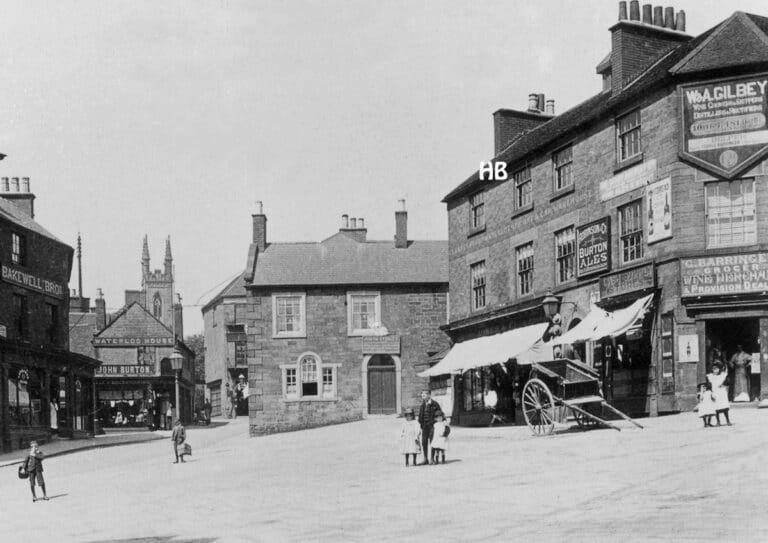
The north side of the Market Place c.1895. From left, Bakewell Brothers Grocers, draper John Burton, the White Swan Public House and grocer George Barringer.
Bakewell Brothers (on the far left) was established in 1866 but was owned by just James Bakewell after the first three years. His grocery store and warehouse were very successful, and he was the first Belper person outside the Strutt family to own his own motor car. He sold his store to the Ripley Co-operative Society in 1896.
Beyond Bakewell Brothers is Waterloo House, owned by a series of drapers, with John Burton taking over sometime between 1891 and 1895. A fire in February 1900 badly damaged the building and it was then demolished to allow the junction to be widened.
Tucked away by the junction is Loving’s Ironmongers – so well known at the time that a regular meeting place in the town was ‘Loving’s Corner’. John and Ellen Loving lost their 23-year-old son William in the First World War, and closed the business shortly afterwards.
The White Swan first appears in the 1835 trade directories, run by John Watson, but he was running the ‘Upper Swan’ for at least 13 years before that, and G. Watson was there in the first trade directory of 1811, so it’s likely the name changed from ‘Upper’ to ‘White’ Swan.
The range of shops on the right include Jones and Company, described as ‘clothiers’ in the trade directories. By 1899 they had closed, after only a few years. George Barringer ran the grocery store on the corner, although was there only briefly. By 1900 Sarah Jewkes was running it as a greengrocers and fishmongers. Barringer’s main shop was on the corner of King Street and Bridge Street (later replaced by the London and Midland Bank).